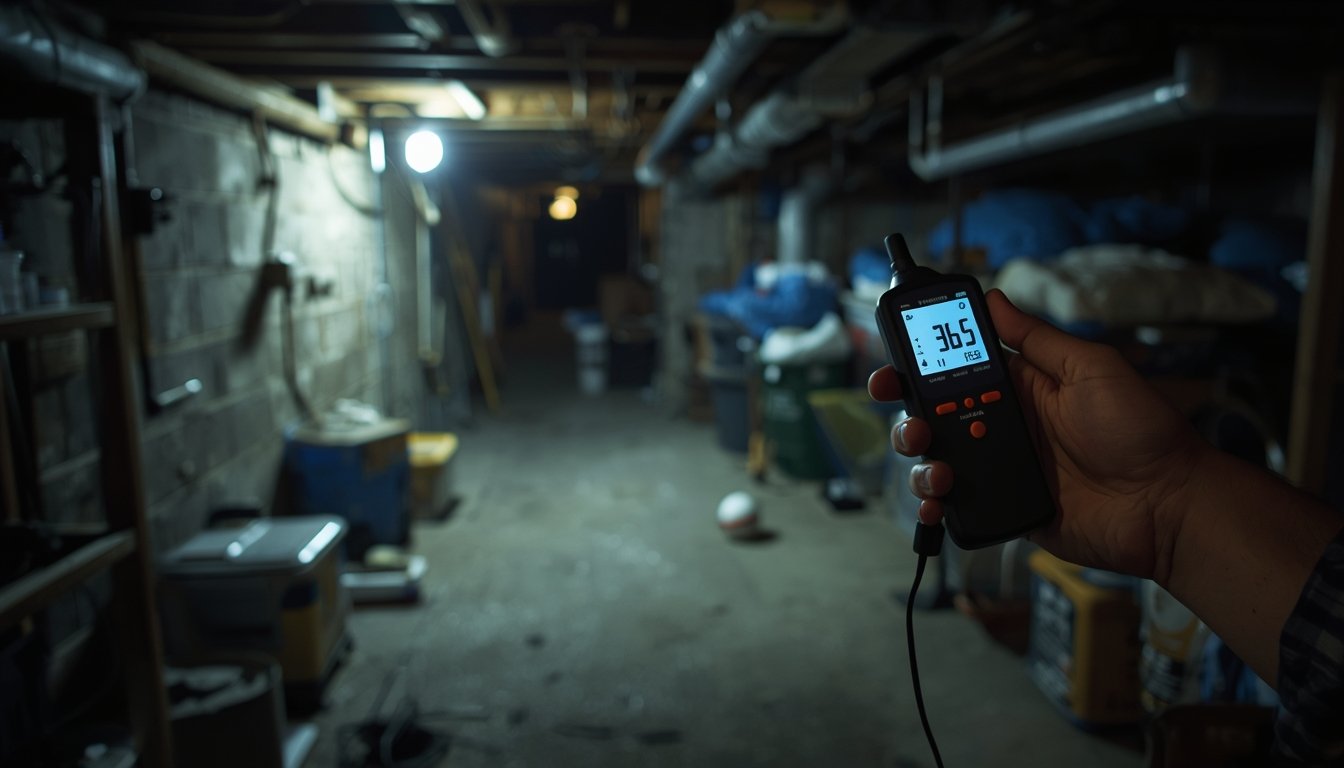
Humidity meters come in several types, including digital, analog, and specialised sensor-based models, each designed to measure moisture in the air in slightly different ways. Choosing the right type depends on how accurate you need the readings to be, where you plan to use the device, and how often you want to monitor humidity.
Digital Humidity Meters (Most Common for Homes)
Digital humidity meters are the most widely used option for homeowners because they are easy to read, affordable, and generally reliable. These devices use electronic sensors to detect moisture levels and display the result as a percentage on a screen.
Most digital models also include a temperature reading, which helps you understand how humidity and temperature interact. This is useful because relative humidity changes depending on temperature, even if the amount of moisture in the air stays the same.
In everyday use, digital meters are practical because they give fast readings and require little setup. You can place them in a room, wait a few minutes, and get a clear picture of your indoor conditions.
If you’re just getting started, this humidity meter guide explains how these devices fit into managing indoor comfort and moisture levels.
While digital meters are convenient, their accuracy can vary depending on quality and placement. However, for most home uses, they provide more than enough precision to detect problems and maintain balance.
Analog Humidity Meters (Simple and Mechanical)
Analog humidity meters use a mechanical system rather than electronic sensors. These devices often rely on materials that expand or contract based on moisture levels, such as a coil or strip, which moves a needle on a dial.
One advantage of analog meters is that they do not require batteries or power. This makes them useful for long-term placement in areas where you don’t want to worry about maintenance.
However, analog meters are generally less precise than digital ones. They can drift over time and may need occasional calibration to stay accurate. For this reason, they are often used for general monitoring rather than detailed measurement.
Despite these limitations, analog meters can still be useful in certain situations. For example, they are commonly used in storage areas, workshops, or spaces where a simple visual reference is enough.
They also tend to be more durable and less sensitive to environmental changes, which can be an advantage in rougher conditions.
- Digital meters provide fast, clear readings on a screen
- Analog meters use a needle and dial for simple monitoring
- Digital models often include temperature readings
- Analog models do not require batteries or power
- Digital meters are generally more precise than analog
Capacitive and Resistive Sensors Explained
Most modern humidity meters, especially digital ones, rely on either capacitive or resistive sensors. These sensors are the core components that detect moisture in the air and convert it into a readable value.
Capacitive sensors measure changes in electrical charge as humidity levels shift. They are widely used because they are stable, accurate, and suitable for a wide range of conditions. These sensors are commonly found in higher-quality digital meters.
Resistive sensors, on the other hand, measure changes in electrical resistance as moisture interacts with the sensor material. While they are often less expensive, they can be slightly less stable over time compared to capacitive sensors.
For most homeowners, the difference between these sensor types is not something you need to worry about daily. However, understanding that different technologies exist helps explain why some meters are more accurate or consistent than others.
In general, devices using capacitive sensors tend to offer better long-term reliability, especially in environments where humidity levels fluctuate frequently.
Specialised Humidity Meters for Specific Uses
Beyond basic digital and analog models, there are specialised humidity meters designed for specific environments or tasks. These are often used in situations where more precise or targeted measurements are required.
For example, some meters are designed for use in basements or crawl spaces, where moisture levels can be higher and more variable. Others are built for monitoring storage conditions, such as in wine cellars or instrument cases.
There are also combined devices that measure both humidity and other factors, such as air quality or dew point. These can provide a more complete picture of indoor conditions, especially in environments where multiple factors interact.
While these specialised devices can be useful, they are not necessary for most homes. In many cases, a standard digital humidity meter provides enough information to manage indoor comfort and prevent common issues.
Choosing a specialised device usually depends on whether you have a specific problem or need more detailed data than a basic meter can provide.
- Basement and crawl space meters handle damp conditions
- Storage meters help protect sensitive items
- Combined devices measure humidity and additional factors
- Some models track long-term humidity trends
- Specialised meters are useful for targeted monitoring
How to Choose the Right Type for Your Home
Choosing the right humidity meter comes down to how you plan to use it. For most homes, a simple digital meter is the best starting point because it balances accuracy, ease of use, and cost.
If you want quick, clear readings and the ability to move the device between rooms, a digital model is the most practical choice. It allows you to monitor different areas and identify patterns without needing multiple devices.
If you prefer a low-maintenance option that doesn’t require batteries, an analog meter may be suitable, especially for general monitoring in less critical areas.
For homes with specific humidity challenges, such as damp basements or storage concerns, a more specialised meter may be worth considering. These devices can provide additional insights and help you manage more complex conditions.
Ultimately, the best choice is the one that fits your needs without adding unnecessary complexity. A reliable meter that you use consistently is far more valuable than a complex device that you rarely check.